
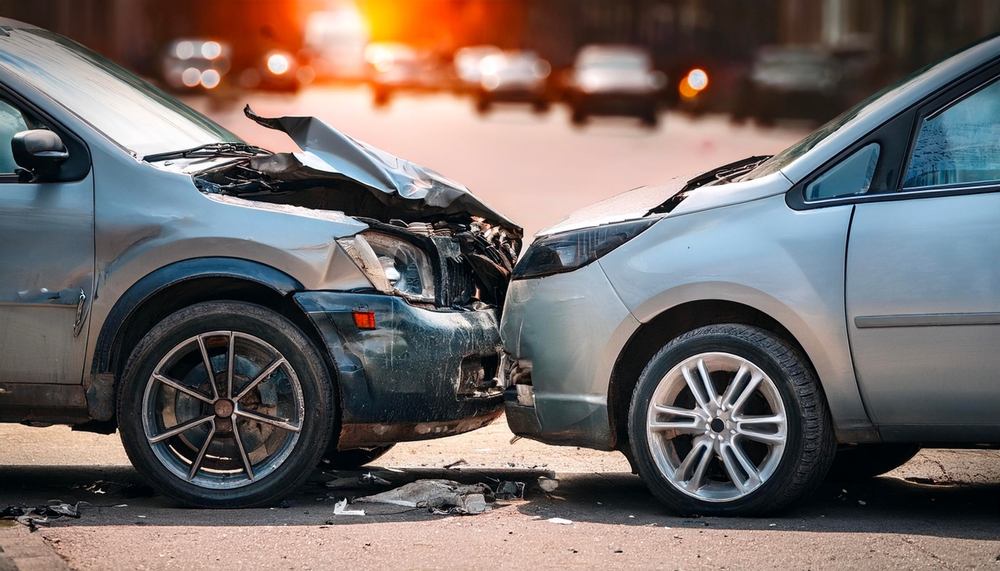
Tulsa Head-On Collision Lawyer
A head-on crash changes a family’s life in seconds, and the recovery that follows is often long and uncertain. If you’re looking for a Tulsa head-on collision lawyer, Lloyd & Lloyd represents people hurt in front-to-front crashes and families who have lost someone in one. We find out why the other driver ended up in your lane and pursue every source of compensation that follows from that answer.
Recovering from a head-on crash takes all of your energy, so let us take on the investigation and the insurance companies. Call 918-246-0200 for a free case evaluation.
Why Are Head-On Collisions So Severe?
 Head-on collisions are among the most dangerous crashes on the road because the speeds of both vehicles combine at impact. Two cars traveling toward each other at highway speed meet with far more force than a car striking a stopped object. The front of each vehicle absorbs the blow, and the people inside take what the crumple zones don’t.
Even at moderate speeds, the combined force often causes serious harm, which is why low-speed head-on crashes on city streets still produce lasting injuries.
Injuries Common in Front-to-Front Crashes
A head-on crash, sometimes called a front-end collision, tends to produce injuries that need long-term care. The forces involved often cause:
- Traumatic brain injuries, including injuries that don’t appear on early scans
- Spinal cord and neck injuries from the violent forward motion
- Chest, rib, and internal injuries from the seat belt, airbag, and steering wheel
- Broken legs, ankles, and feet when the footwell collapses
- Facial injuries and burns
Many of these injuries mean months of treatment, time away from work, and lasting limits on what a person is able to do. Some, like brain injuries, change how a person thinks, works, and relates to family long after the bones heal.
When a Head-On Crash Is Fatal
When a head-on collision takes a life, Oklahoma allows the personal representative of the person who died to bring a wrongful death claim within two years. That claim may include medical and burial expenses, the grief and loss of companionship family members suffer, and the financial support the family lost. We handle these cases with the patience a grieving family needs.
What Causes Head-On Crashes, and Who Is Liable?
Most head-on crashes happen because one driver crossed into oncoming traffic, and Oklahoma’s traffic code makes staying on the right side of the road a legal duty. When a driver breaks one of those rules and causes a crash, that violation is strong evidence of fault. Other parties, including a government agency responsible for the road, may share responsibility in some cases.
The table below matches common causes to the Oklahoma rule involved:
| Cause | Oklahoma rule involved | What tends to prove it |
|---|---|---|
| Drifting over the center line | Drivers must stay on the right half of the roadway on roads of sufficient width | Tire marks, impact location, and crash data |
| Unsafe passing on a two-lane road | Passing is allowed only when the left side is clearly visible and free of oncoming traffic for a sufficient distance | Witness accounts and passing-zone striping |
| Passing on a hill or curve | Driving left of center is barred near the crest of a hill or a curve where the view is blocked | Roadway geometry and sight-line measurements |
| Crossing into a marked no-passing zone | Drivers may not cross to the left within a marked no-passing zone | Road striping and video |
| Impaired or drowsy driving | Driving with a blood or breath alcohol level of 0.08 or more is illegal, and fatigue slows reactions | Toxicology, bar receipts, and work or travel logs |
| Distracted driving or speeding | Drivers must give full time and attention to driving and obey posted limits | Phone records, crash data, and video |
| Wrong-way entry | Drivers on a divided highway must use the right-hand roadway | Ramp video and witness reports |
A traffic citation for one of these violations helps, but the civil claim stands on the evidence even when no ticket was written.
When the Other Driver Was Working
A head-on crash caused by a delivery driver, a contractor’s pickup, or a commercial truck may bring the driver’s employer into the claim. Employers are often responsible for crashes their employees cause on the job, and commercial policies usually carry higher limits than personal auto insurance. We look at who owned the vehicle and why the driver was on the road before settling on the coverage available.
When a Road Defect Played a Role
Missing signs, faded center lines, or poorly marked lane shifts sometimes contribute to a crash, which may bring a city, county, or state agency into the claim. Claims against Oklahoma government entities require written notice within one year of the loss, far sooner than the ordinary filing deadline.
These claims also carry legal limits on liability and exemptions that depend on the facts, so they need early attention. A sign that went missing and stayed missing after the agency learned of it is treated differently from a sign the agency never placed, which is why records about when a problem was reported matter.
What Evidence Reconstructs a Head-On Crash?
A head-on claim usually turns on proving which vehicle left its lane and why. Physical evidence at the scene answers that question most reliably, but it is cleared away quickly once tow trucks and road crews arrive. We work to capture it before it disappears.
Evidence we gather includes:
- Accident reconstruction based on vehicle damage, final resting positions, and the point of impact
- Event data recorder downloads from both vehicles showing speed, braking, and steering before impact
- The debris field, gouge marks, and fluid trails that show where the vehicles met
- Statements from witnesses, first responders, and other drivers
- Road design, striping, and maintenance records when a roadway issue may be involved
- Photos, video, and the official crash report
Accident reconstructionists use these pieces together to show where each vehicle was in the seconds before impact.
Why Both Vehicles’ Data Matters
Crash data from your own vehicle may show you were in your lane, at a lawful speed, and braking before impact. Paired with the other vehicle’s data, it often settles a fault question that the drivers’ memories leave open. We ask for the other vehicle’s data early, because a totaled car may be salvaged or crushed soon after the insurer takes possession.
Head-On Crash Risks on Highways Around Tulsa
Head-on crashes are most common on roads where opposing traffic travels close together at speed with nothing between the lanes. Undivided stretches of state highways, passing zones on two-lane roads, and work zones where traffic shifts into a single lane each way all raise the risk. The highways serving Sand Springs and Tulsa include several of these conditions.
US-412, US-64, SH-51, and SH-97 all run through Sand Springs and western Tulsa, and construction regularly reshapes lanes on them. The Oklahoma Department of Transportation has narrowed US-412 to one lane in each direction over Shell Creek in Sand Springs through early 2027 for bridge work. Lane shifts like these put oncoming cars within a few feet of each other, which leaves little room for a driver who drifts or misjudges a curve.
Rural Roads and Delayed Help
Crashes on less-traveled stretches outside the city core may go unreported for minutes, and witnesses may be few. That makes physical evidence and vehicle data even more important to the claim.
Delayed emergency care may also worsen injuries. The first responder notes and hospital records help document that timeline.
What Losses May a Head-On Collision Claim Include?
 A head-on collision claim in Oklahoma may include every financial and personal loss the crash caused, now and in the future. Because these injuries are so often serious, the future side of the claim frequently outweighs the bills already paid. A complete claim accounts for:
- Hospital care, surgery, rehabilitation, and future medical treatment
- In-home care, medical equipment, and changes to a home or vehicle
- Lost wages and reduced ability to earn over a working lifetime
- Pain, physical impairment, scarring, and emotional distress
- Vehicle repair or replacement and other property losses
Projecting future care often takes input from treating doctors and other professionals. We gather that support before negotiating, so an early offer doesn’t lock you into a number that ignores what recovery actually requires.
How Does Oklahoma’s Comparative Fault Rule Apply?
Oklahoma’s modified comparative negligence rule lets you recover as long as your share of fault isn’t greater than the other driver’s. Your award is then reduced by your percentage of fault. In head-on cases, insurers sometimes argue the injured driver was speeding or slow to react.
Suppose a jury values your losses at $250,000 and finds the other driver 85% at fault for crossing the center line and you 15% at fault for driving over the limit. You recover $212,500. That math is why we push back on every percentage an insurer tries to assign to you.
When the Insurer Pushes an Early Offer
Insurers sometimes make a quick offer on a head-on claim while the injured person is still in treatment and worried about bills. Accepting it usually ends the claim, and the full cost of a serious head-on injury is rarely clear that early. The at-fault driver’s limits, your own uninsured and underinsured motorist coverage, and any employer’s policy all need to be known before a number makes sense.
The Two-Year Filing Deadline
Most Oklahoma injury lawsuits must be filed within two years of the crash, though exceptions may change that period. A claim involving a government entity requires the much earlier written notice described above.
How Lloyd & Lloyd Builds a Head-On Collision Case
Serious head-on claims need early investigation and a clear account of how the crash unfolded. Jim Lloyd, Nancy Lloyd, and James (Buddy) Lloyd II lead that work for injured people and grieving families from Sand Springs to the far side of Tulsa.
Our approach includes:
- Early scene work: We secure photos, video, and physical evidence before road crews and weather erase it.
- Data from both vehicles: We request event data recorder information from the other driver’s vehicle and preserve yours.
- A look past the driver: We check whether road design, signage, or an employer’s role adds another responsible party.
- Attention to long-term needs: We document future care, lost earning capacity, and the daily limits serious injuries create.
The value and outcome of any claim depend on its specific facts. If you or a family member was hurt in a head-on crash, call 918-246-0200 for a free case evaluation.
FAQs: Tulsa Head-On Collisions
Who is at fault in a head-on collision in Oklahoma?
The driver who left their lane is usually at fault in an Oklahoma head-on collision, but not always. A driver forced over by another car or swerving around a hazard someone else created may not carry all of the responsibility, so the investigation decides fault rather than the point of impact alone.
Is a passenger able to sue after a head-on collision?
Yes. A passenger hurt in an Oklahoma head-on crash may bring claims against the driver who crossed over and, if both drivers made mistakes, against the driver of the car they were riding in. Each at-fault driver pays only their own share of the damages, so passengers often need claims against both.
Who decides fault after a head-on crash, the police or the insurance company?
Neither has the final word. The police report is evidence, and each insurer reaches its own conclusion about fault, but if a claim goes to court in Oklahoma, a judge or jury decides fault from all the evidence, including evidence the officer never saw.
How long does a head-on collision case take in Oklahoma?
No set timeline applies to a head-on collision case in Oklahoma. Claims with serious injuries usually wait until treatment reaches a stable point so future care is known, and a case that goes to suit in Tulsa County District Court takes longer than one resolved through negotiation.
What if the other driver's insurance company denies my head-on claim?
A denial from the at-fault driver’s insurer doesn’t end an Oklahoma head-on claim. The insurer’s view of fault isn’t binding, and the claim may still go forward through a lawsuit filed within the two-year deadline. While that plays out, your own medical payments or uninsured motorist coverage may help, depending on your policy.
Help for the Long Road Back
Recovery from a head-on crash rarely follows a straight line, and the claim needs to account for every part of it. The sooner the investigation starts, the more scene evidence remains.
Lloyd & Lloyd investigates how the crash happened, identifies everyone responsible, and pursues the compensation your recovery requires. If a head-on collision on a Tulsa road hurt you or someone you love, call 918-246-0200 for a free case evaluation.
GET THE EXPERIENCE YOU NEED FOR YOUR CASE
If you have been injured due to the fault of others, contact Lloyd & Lloyd. Our record of success in the courtroom and in the courts of appeal, combined with our commitment to giving personal service, enable us to provide exceptional legal representation. You can fill out an online case review form by clicking here, or by calling us at (918) 246-0200.